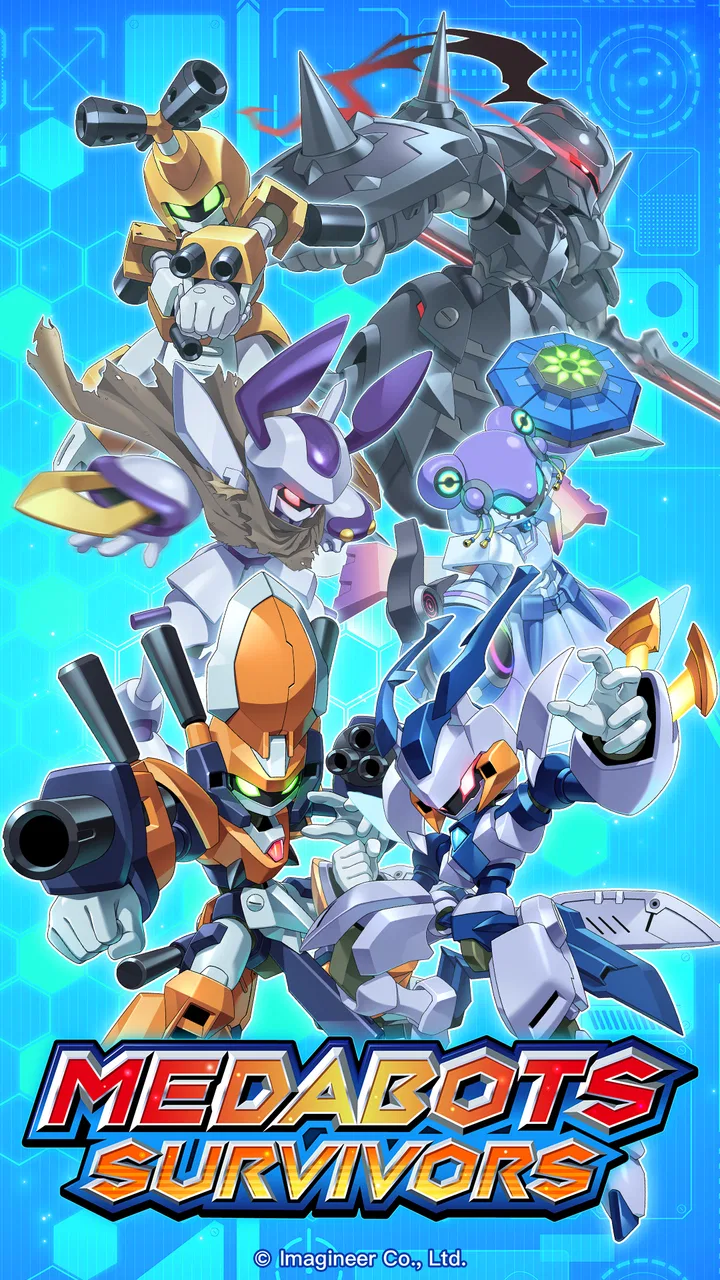
Medabots Survivors
- 4.3
- Rating
- 100.00K
- Installs
- Free
- Price

 Analysis by App-foxy
I went into Medabots Survivors expecting a quick action game built around the familiar Medabots idea, but what stayed with me was its simple question: how much can one decision change the next few minutes? The game is free to play, made by Imagineer Co.,Ltd., and its store summary, “Your choices determine the future,” is a fair description of the mood. It is not asking me to admire a passive collection of characters; it wants me to act, react, and decide whether a risky run is worth continuing.
That makes it easier to understand than many mobile action games. I can start a session without learning a large set of systems first, see the immediate result of my choices, and then decide whether to try again. The loop is the main attraction: enter the action, deal with pressure, collect the benefit of surviving, lose or finish the attempt, and begin again with a better idea of what I should do next.
It currently holds a 4.4 average from around 7.5 thousand ratings, with more than 100 thousand installs. Those figures suggest that it has found an audience, but they do not remove the need to ask whether the game suits your habits. I think it works best for players who enjoy short, repeatable action sessions and gradual improvement. If you want a deep story-first role-playing game or a completely relaxed experience with no pressure, this is probably not the right place to start.
You May Also Like

 AccuWeather: Weather Radar
AccuWeather Review: A Quick, Clear Forecast for Everyday Decisions
For everyday plans, the best forecast is the one you can understand quickly. AccuWeather makes rain timing, radar, and local conditions easy to act on, with a few trade-offs.

 Hill Climb Racing
Why Hill Climb Racing Still Turns Crashes Into One More Run
A tiny car, a bumpy hill and one more upgrade: Hill Climb Racing keeps resurfacing because its simple chaos makes every near-miss feel personal.

 AliExpress - Shopping App
AliExpress Makes Global Shopping Feel Personal, but Shoppers Bear the Risk
AliExpress turns a global marketplace into a pocket-sized discovery engine. Its reach is useful, its shopping loop compelling, and its trade-offs easy to miss.

 Lords Mobile: Kingdom Wars
Lords Mobile Is a Kingdom-Building Routine, Not a Quick Match
A case-by-case verdict on the building, battles, device demands, and social commitments that make Lords Mobile rewarding for some players and exhausting for others.

 PDF Scanner app - TapScanner
TapScanner Makes Paperwork Easier to Capture, Check, and Share
TapScanner makes scanning with a phone feel less like a rescue operation and more like a dependable step in getting work done. Its capture tools are useful, though not flawless.

 Block Blast!
 Shows How Much a Puzzle Game Can Leave Out
A quiet grid game shows why puzzle players increasingly value instant clarity, repeatable skill and low-pressure play—and where the genre still needs to catch up.
More From Our News Desk
View All News


How the first action sets the tone
The first useful thing to notice is how quickly the game gets to its central activity. Rather than burying the action beneath a long introduction, it presents the kind of decision-making that defines the experience: move with purpose, respond to danger, and think about what the next moment may require instead of only reacting to what is already on screen.
I like that opening because it gives the game a clear identity. The Medabots setting provides a recognizable frame, but the appeal does not depend entirely on knowing every detail of the franchise. A newcomer can approach it as an action game, while an existing fan has an extra reason to care about the machines and the choices surrounding them.
The first action is also where I would advise new players to resist rushing. In a game built around repeated attempts, the opening moments are not disposable. They are a chance to learn the pace of threats, notice which decisions create breathing room, and understand how aggressively the game expects you to play. A careful first run can teach more than a reckless attempt that ends quickly.
That is one of the less obvious strengths of the design: failure can be useful even when it does not feel rewarding immediately. I found myself remembering the decision that caused trouble rather than simply blaming the game. Did I move into a crowded area because I wanted a faster reward? Did I continue a risky exchange when retreat would have been wiser? Those questions make the next session feel purposeful.
The action category is a good fit because the game depends on attention rather than passive waiting. Even when the controls feel approachable, the player still has to read the situation. That distinction matters for mobile play. It is easy to pick up during a break, but it is not automatically mindless, and I would not recommend treating it like a background activity while doing something else.
Why the feedback rhythm matters
Once the first few moments pass, the game’s strongest quality is its feedback rhythm. I take an action, see how the battlefield responds, receive a sign that the choice helped or hurt, and immediately have to decide what comes next. That sequence is what gives the sessions their momentum. Without it, the game would feel like a series of disconnected encounters; with it, each choice becomes part of a chain.
Good mobile action games make the result of a decision readable. Medabots Survivors benefits from that same principle. When I take a safer route, the advantage should be visible in the extra room it gives me. When I push forward for a better opportunity, the cost should be clear if the situation becomes harder to control. This kind of feedback encourages experimentation without requiring a long tutorial for every possibility.
The rhythm also creates a useful tension between immediate safety and future value. A conservative choice can preserve a run, but it may leave me feeling that I missed an opportunity. A more ambitious choice can make the session exciting, yet it can also turn a promising attempt into a reset. I appreciate that trade-off because it gives the action a reason to continue beyond simply clearing whatever is directly in front of me.
My practical advice is to identify the point where your attention starts to drop. If you are playing while tired, the game’s repeated decisions can become less satisfying because you will make choices automatically. I get better results when I treat a run as a focused activity, even if the session itself is short. That approach also makes the feedback easier to read, especially when the screen becomes busy.
Another useful habit is to change only one part of your approach after a failed attempt. If I change everything at once, I cannot tell which adjustment helped. If I alter my movement, risk level, or choice of reward one at a time, the next run becomes a small experiment. That is a simple method, but it turns repetition into learning instead of making each reset feel identical.
Rewards that make another attempt tempting
The reward stage is where the game answers the question, “Why should I play again?” A successful decision is not only satisfying because it avoids danger; it should also improve the position from which the next decision is made. That connection between action and reward is what keeps the loop from feeling empty.
I found the best rewards are the ones that support a clear plan. If I know what kind of run I want to build, a reward becomes more than a shiny interruption. It becomes a tool for shaping the rest of the session. The interesting choice is not always the strongest-looking option. Sometimes the safer or more flexible benefit is better because it protects the run from the next difficult sequence.
This is where Medabots Survivors can appeal to players who enjoy light strategy inside an action format. You are not pausing for a lengthy planning screen, but you are still making decisions that influence how comfortable the next stretch will be. I would not describe it as a substitute for a large tactical role-playing game. Its thinking is quicker, more immediate, and tied closely to the pressure of the current run.
There is also a psychological reward in recognizing improvement. On an early attempt, I may only be trying to stay alive. Later, I can start judging whether I am taking the right risks at the right time. That change in perspective is important. The game does not need every session to feel dramatically different if my understanding of the loop is becoming sharper.
The free-to-play structure deserves attention here. The game can be downloaded without an entry price, while in-app purchases range from about one dollar to roughly one hundred twenty-five dollars per item. That wide range means I would approach spending carefully. I recommend playing long enough to understand the basic loop before paying for anything, then deciding whether a purchase improves your enjoyment or merely encourages you to continue when you are no longer having fun.
For younger players, the Everyone content rating makes the game broadly approachable, but that does not automatically make spending decisions simple. Anyone sharing a device should still be clear about how purchases are handled. My own rule would be to enjoy the free starting experience first and treat optional spending as a separate decision, not as part of learning the game.
The reset is part of the design, not a punishment
Every repeatable action game eventually reaches the reset. A run ends, progress inside that attempt is lost or concluded, and the player returns to the starting point. Whether that feels motivating or irritating depends on what the game teaches before the reset. In my experience, Medabots Survivors works best when I view the end of a session as a report on my decisions rather than a simple rejection.
The reset gives the game its reason to exist as a repeatable experience. If every attempt permanently solved the problem, there would be less room for adaptation. Starting again lets me test a different level of caution, respond earlier to danger, or pursue a reward that I ignored before. The next session begins because I now understand the previous one slightly better.
That does not mean every reset feels equally fair. Repetition can become tiring when I make the same opening choices and see the same problems without a meaningful adjustment. This is the main friction I would mention to a friend: the game asks you to accept that improvement may come from your own judgment rather than from a dramatic change after every attempt. Players who need constant new content may find that structure too narrow.
A realistic everyday use case is a short evening break after work or study. I can play one run, notice that I was too aggressive near the end, and close the game without committing to a long campaign. If I have more time, I can immediately try again with a specific goal. That flexibility is valuable, but I would avoid starting a session when I need to leave instantly, because the action still benefits from concentration.
The reset also helps answer a common question: is this suitable for people who dislike losing progress? My answer is conditional. If you dislike losing a run but enjoy learning from failure, it may still work. If any restart feels like wasted time, the structure will probably frustrate you. This is not the kind of action game I would choose for someone who wants uninterrupted advancement every time they play.
Who will enjoy the Medabots approach
Medabots Survivors is a good match for players who want action with a decision layer, especially those who like repeating a challenge to improve their judgment. It is also a sensible entry point for Medabots fans who want to see the property used in a more active format rather than only as a collection or story reference.
I would recommend it to someone who enjoys asking practical questions during play: should I take this chance, conserve my position, or prepare for what may follow? The game is most engaging when those questions matter to you. It can turn a short session into a small problem-solving exercise without demanding the complexity of a full strategy title.
I would skip it if your ideal mobile game is a calm puzzle, a long narrative adventure, or a competitive experience where every match is tightly balanced against another human. This game’s appeal comes from its own repeatable action loop, not from replacing those other formats. Players who want a huge roster-management system should also keep their expectations measured; the central experience here is the run and the choices within it.
Compared with a typical endless action game, the Medabots identity gives the loop more personality, while the decision-and-reset structure gives it more thought than simple reaction-based play. Compared with a traditional role-playing game, it is quicker and less concerned with long-term storytelling. That middle position is its advantage, but also its limitation: it may feel too involved for casual tapping and too compact for players seeking a large adventure.
Practical expectations before installing
The game is listed for Android devices running version 8.0 or later, and the current version is 2.1.0. That makes checking your operating system a sensible first step before installing. I also recommend leaving enough attention for the opening session rather than judging it from a few rushed actions. The loop becomes clearer once you have experienced an action, a reward, a setback, and the decision to begin again.
Because the game is free to start, the most sensible evaluation method is straightforward: install it, play without spending, and decide whether the basic rhythm is enjoyable on its own. Pay attention to whether you look forward to the next run or merely feel pushed to continue after a disappointing one. That difference tells you more about long-term fit than the presence of optional purchases.
New players should also avoid copying an aggressive style simply because it looks exciting. Early caution can reveal how the game communicates danger and opportunity. Once those signals become familiar, taking risks becomes more satisfying because the choice is informed. In my view, that is a better way to approach the game than chasing the biggest immediate reward every time.
Finally, remember that the Medabots theme is a bonus rather than a requirement for understanding the action. Fans will likely enjoy the connection more deeply, but newcomers can judge the game through its rhythm: action creates feedback, feedback informs the next choice, rewards encourage a longer push, and the reset creates a reason to try again.
My verdict on the complete loop
Medabots Survivors succeeds when its five-part cycle stays connected. The first action gets me moving, the feedback tells me whether my judgment is working, the reward gives the next decision meaning, and the reset turns mistakes into a reason to return. That is a clean foundation for a mobile action game, and it explains why I can enjoy a short session without needing a large time commitment.
Its limitations are just as clear. Repetition will not suit everyone, free-to-play purchases require self-control, and players looking for a deep campaign or a constantly changing structure may prefer another genre. The game asks me to supply some of the motivation by noticing my own improvement. When I am in that mindset, the loop feels rewarding; when I want the game to provide a new spectacle every few minutes, it feels more restrained.
Overall, I would recommend it to Medabots fans and to mobile players who like action that leaves room for quick decisions. The strongest reason to return is not simply that a run ended, but that I can identify one choice to improve in the next attempt. If that kind of personal progression sounds appealing, the free entry point makes it easy to test. If repeated resets sound exhausting, it is better to choose a more linear action game instead.
My final recommendation is to try it for the loop, not just the license. The Medabots setting gives the game its character, but the lasting appeal comes from the small cycle of acting, reading the result, choosing a reward, and starting over with a clearer plan. That is where this action game earns its place on my phone.
FAQs for Medabots Survivors
01What is Medabots Survivors about?
Medabots Survivors is a strategic RPG where players collect, customize, and battle with Medabots—robotic companions with unique abilities. Set in a futuristic world, players engage in thrilling tournaments and complete missions to advance their skills. The game combines strategy, customization, and competitive combat, making it engaging for fans of tactical gameplay.
02What platforms is Medabots Survivors available on?
Medabots Survivors is available for both Android and iOS devices. You can download it from the Google Play Store or the Apple App Store, ensuring compatibility with a wide range of smartphones and tablets. Ensure your device meets the minimum system requirements for an optimal gaming experience.
03Does Medabots Survivors require an internet connection?
Yes, Medabots Survivors requires an internet connection to access certain features, such as multiplayer battles, updates, and in-game purchases. While some offline gameplay is possible, staying connected ensures you can fully enjoy all the game’s features and participate in global tournaments.
04Are there in-app purchases in Medabots Survivors?
Medabots Survivors offers in-app purchases to enhance your gameplay experience. Players can buy in-game currency to unlock special items, upgrade Medabots, and access exclusive content. While not necessary to enjoy the game, these purchases can provide a competitive edge in battles and quicker progression.
05How does customization work in Medabots Survivors?
Customization in Medabots Survivors allows players to modify their Medabots with different parts and weapons to suit their strategies. Each part affects the Medabot's abilities and stats, offering a deep layer of strategic planning. Players can experiment with various combinations to create the ultimate robotic warrior tailored to their play style.
Pros
- Engaging storyline with rich character development.
- Customizable Medabots enhance gameplay variety.
- Smooth graphics and animations enhance experience.
- Strategic combat mechanics keep players engaged.
- Frequent updates with new content and features.
Cons
- In-app purchases can be quite expensive.
- Occasional connectivity issues during battles.
- Requires a stable internet connection to play.
- Some players find the tutorial too lengthy.
- Limited energy system restricts playtime.

Medabots Survivors
Gallery